How much chemistry goes into making a good cup of coffee? And how does maths help an industrial company manage thousands of products each day?
These were the questions that upper school pupils explored with us at the start of July. Over two lively project days, we welcomed the advanced chemistry class from Wim-Wenders-Gymnasium, followed a few days later by the advanced maths class.
We wanted to show how classroom learning connects to real business practice, and how many different career paths are possible in a medium-sized chemical company.
Experiencing chemistry instead of just talking about it
The chemistry project day started on 3 July, organised by Klaus, Marie from our technical customer service team, and our new colleague Lena from the HSE department. After a short introduction to the company, we asked a question that surprised everyone:
What does chemistry actually have to do with coffee?
The answer is surprising. With our cleaning solutions, we ensure that coffee machines remain hygienically clean and that coffee can consistently develop its full flavour. Limescale deposits, milk residues and residues from coffee beans present very different challenges, which can only be reliably solved with the right cleaning approach.
So, the day focused on descaling.
After learning about Sinners’ Circle, which covers the four factors of chemistry, mechanics, temperature, and time, the students worked in small groups at different experiment stations. They tested how various acids, temperatures, and even ultrasound affected descaling, and looked for the most energy-efficient method. It soon became clear that cleaning should be both effective and sustainable.
At another station, coffee was made in different ways. Even though the same coffee bean was used, the cold brew, French press, and Kazumi Coffee methods created three very different flavors, which everyone tasted together.
Over a shared lunch of fresh bowls, the results of the experiments were discussed, and many questions about chemistry, sustainability and day-to-day working life at Schulz & Sohn were answered.
Mathematics: The Foundation of Business Decisions
Just a few days later, the focus shifted to another subject that is often underestimated: mathematics.
With the advanced mathematics class, we showed that mathematical thinking is about much more than just formulas and equations. Sales forecasts, investment decisions, and profitability calculations all rely on mathematical models.
The students took on roles in sales, financial control, and senior management. In group tasks, they analysed sales trends, calculated the break-even point, assessed investments, and discussed the opportunities and risks of their decisions.
Another important topic was how a modern industrial company works. By looking at our material, information, and financial flows, it became clear how many processes must work together every day to make sure a product reliably reaches the customer.
To finish the event, our Managing Director, Mark, held an open Q&A session, sharing personal insights into daily business operations. Topics like artificial intelligence, sustainability, career paths, and the future of medium-sized companies led to interesting and open discussions.
A Look Behind the Scenes
Both project days showed how valuable it is for schools and businesses to work together. Hands-on experience brings theory to life and opens up new ideas for future careers.
We sincerely thank all team members who prepared and supported these two events with dedication. Special thanks to Klaus, Mark, Marie, Lena, and Nadja for organising, and to all the students for their curiosity, questions, and great discussions.
We are already looking forward to the next visit and hope to keep inspiring young people to explore chemistry, maths, and the many roles in our company.
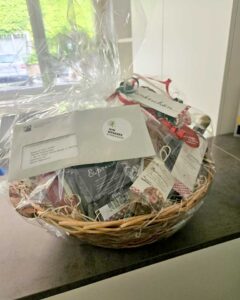
Thank you for the wonderful hamper!


